 Do some client recommendations work better than others? Social proof is such a strong trigger for online action, it’s good to know what works best for your Web content marketing strategies.
In a previous post, What Clients Say, I reported on research that showed people selected travel destinations 20 percent more with a client recommendation and a photo of the reviewer.
Research studies show that some ratings and reviews will influence more than others: This report is taken from Dr. Susan Weinschenk’s book Neuro Web Design: What Makes Them Click:
- We are most influenced when we know the person and the person is telling a story. But quite often, it’s unlikely we will actually know a person doing an online review, unless they are a well-known author or respected expert in the field.
- We are somewhat less influenced when we don’t know them, but we can imagine them because their is a name, a company name, a link to their site, and maybe a persona description of them (like, for example, a stay-at-home mom, a runner, a CEO, a Ph.D.)
- We’re even less influenced when we don’t know the person, can’t imagine them, but we we are at least provided with a story.
- We are least influenced when we don’t know the person and we’re only provided with a rating.
Here’s another way of looking at the degree to which a client recommendation will work to convince readers to take action:
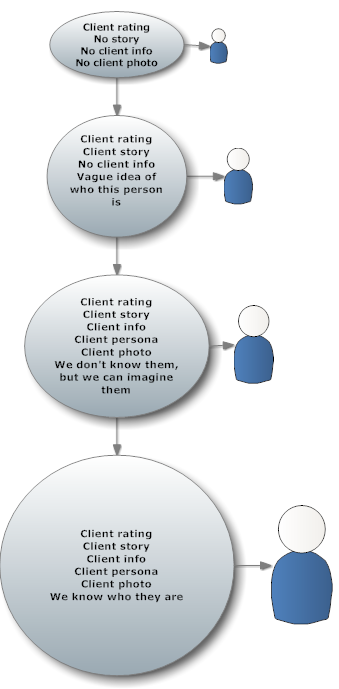 Clearly, there are advantages in sharing as much as possible about the reviewer leaving a rating or comment. For example, a persona might include a description of the reviewer such as “A patent attorney,” or “a work-at-home parent,” or, “a daily tennis player.” Photos and links to web pages that tell about the person are ideal.
I think the worse are the ones with just initials, like R.M., or Robert M. It’s as if they are hiding the identity for fear you’ll try to contact them.
If you are required to keep client identities anonymous, as in the case of therapists or lawyers, for example, you can at least provide some identifying characteristics such a profession and approximate age: ” – “a 40-year-old mother of two,” or, “a middle-aged successfully recovering alcoholic.”








Recent Comments